99.9Wh Portable Power Bank with 21700 Battery
Blog | Published by Alex on October 20, 2026
99.9Wh Power Bank Integrated with 21700 NCM Lithium-ion Batteries
Battery specification: NMC Lithium-ion 21700 battery with steel casing, grade-A power lithium battery, max 3C continuous discharge rate (13.5A), 800 cycles (80% DOD).
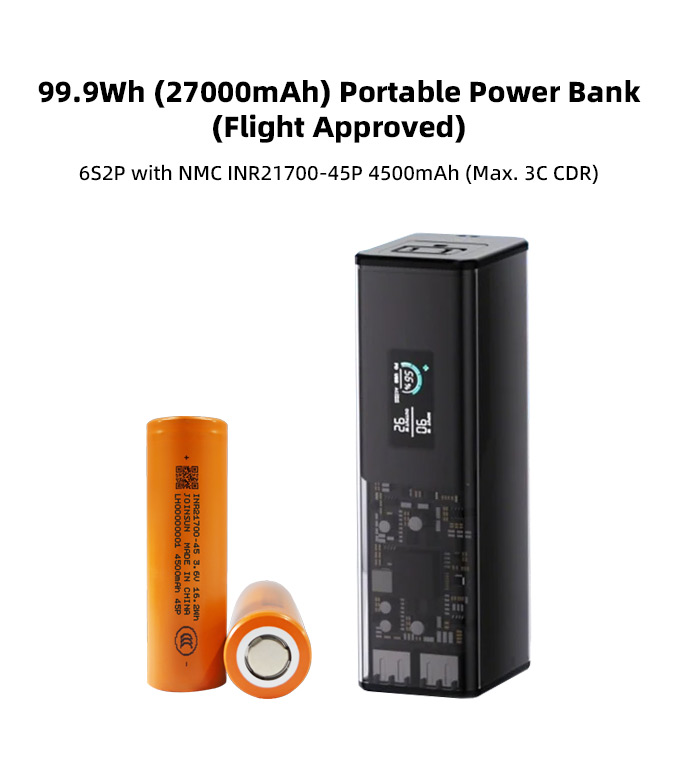
Rated 99.9Wh, 27000mAh@3.6V.
The nominal voltage of single 21700 battery is 3.6V. This product adopts 6 series 2 parallel (6S2P) architecture.
(1) 6S: Battery pack voltage 22.2V
(2) 2P: Two 21700 batteries connected in parallel per branch, with a total of 12 cylindrical 21700 batteries.
The marked 27000mAh of PACK is equivalent capacity at 3.6V. The actual PACK capacity is 4500mAh under 22.2V of the battery pack. Under 2P configuration, the capacity of single 21700 battery is 4500mAh.
This solution adopts 4500mAh, 3C power type 21700 battery, total 12 pieces, 6S2P configuration. Total energy = 22.2V × 4.5Ah = 99.9Wh, fully matching the marked 99.9Wh on nameplate.
Characteristics of internal 21700 battery
1. Balanced energy density and compact size: Compared with 18650 batteries, 21700 battery features higher capacity per cell. Higher energy storage capacity can be achieved with the same quantity of batteries for compact overall structure.
2. 3C high-rate discharge: Supports total output of 160W, continuous AC output of 100W and peak 150W. USB‑C PD3.1 supports maximum 140W output. It maintains good voltage drop control under high-current conditions, suitable for powering laptops, drones, mini refrigerators and other loads.
3. Aviation compliance design: Total energy controlled at 99.9Wh, below the 100Wh limit for portable energy storage products carried on board civil aviation. It is allowed to be carried in cabin but cannot be checked in. The steel casing of 21700 battery together with BMS realizes multi-protection including overcharge, over-discharge, overcurrent and temperature control, meeting basic safety requirements for air transportation.
4. Fast charging compatibility: Supports maximum 100W USB‑C bi-directional input for fast full charging. The 21700 battery can withstand high-current charging conditions.
Ports and Performance
(1) Input: USB‑C, max 100W (5V3A~20V5A)
(2) Output: 5 ports, max total output 160W
(3) USB-C1: PD3.1, max 140W for high-power laptops
(4) AC outlet: continuous 100W, peak 150W
(5) Other USB-A output ports
(6) Extra function: LED lighting with constant / strobe / SOS modes, reserved interface for solar charging expansion
(7) Operating temperature: Charging 0~40℃; Discharging -10℃~45℃
Engineering Key Points
(1) 6S BMS Selection: BMS shall support continuous discharge ≥8A, peak 10A or above with balancing function. The 12 cylindrical 21700 batteries require high consistency. Poor consistency will accelerate cycle degradation, enlarge voltage difference during long-term operation and reduce available capacity. The BMS shall also be equipped with protection logic complying with air transportation requirements to prevent abnormal protection triggered by vibration during transit.
(2) Heat Dissipation: Obvious heat generation occurs when AC inverter and high-power PD work simultaneously. Limited heat dissipation space inside enclosure requires temperature-controlled power derating mechanism to avoid high-temperature shutdown and guarantee stability under long-time high-power output. Heat dissipation channels shall be reserved inside housing to reduce local heat accumulation of batteries.
(3) Battery Selection Constraints: Only 21700 battery with discharge rate ≥3C power type can be adopted. Ordinary capacity-type 21700 battery cannot stably sustain simultaneous load of 140W PD and AC port. Excessive temperature rise under large current brings potential safety hazards and fails safety assessment for air transportation.
(4) Safety & Certification: UN38.3, MSDS and other certifications related to air transportation shall be completed. Cylindrical 21700 batteries shall be fitted with anti-rolling and shockproof brackets, with proper insulation isolation design to avoid battery displacement and short-circuit risks caused by bumping during transport. Insulation protection shall be applied among batteries, nickel strips and brackets to reduce failure risk under vibration.
(5) Nameplate Marking: Wh value must be clearly printed on product nameplate. Civil aviation security inspection verifies based on Wh reading. Blurred or incorrect nameplate information will affect boarding. Marking design shall comply with civil aviation inspection specifications.
Alternative Battery Options (4500mAh 21700 Battery, 3C)
Joinusn INR21700-45P, 4500mAh, 3C rate 21700 battery (UL, FCC, CE, RoHS, BIS, PSE), domestic power 21700 battery with same specifications are available alternatives.