The Low Temperature -40°C Challenge for NCM 18650 Batteries: It's Not the Cell, It's the Electrolyte FREEZING
Blog | Published by Alex on May 26, 2026
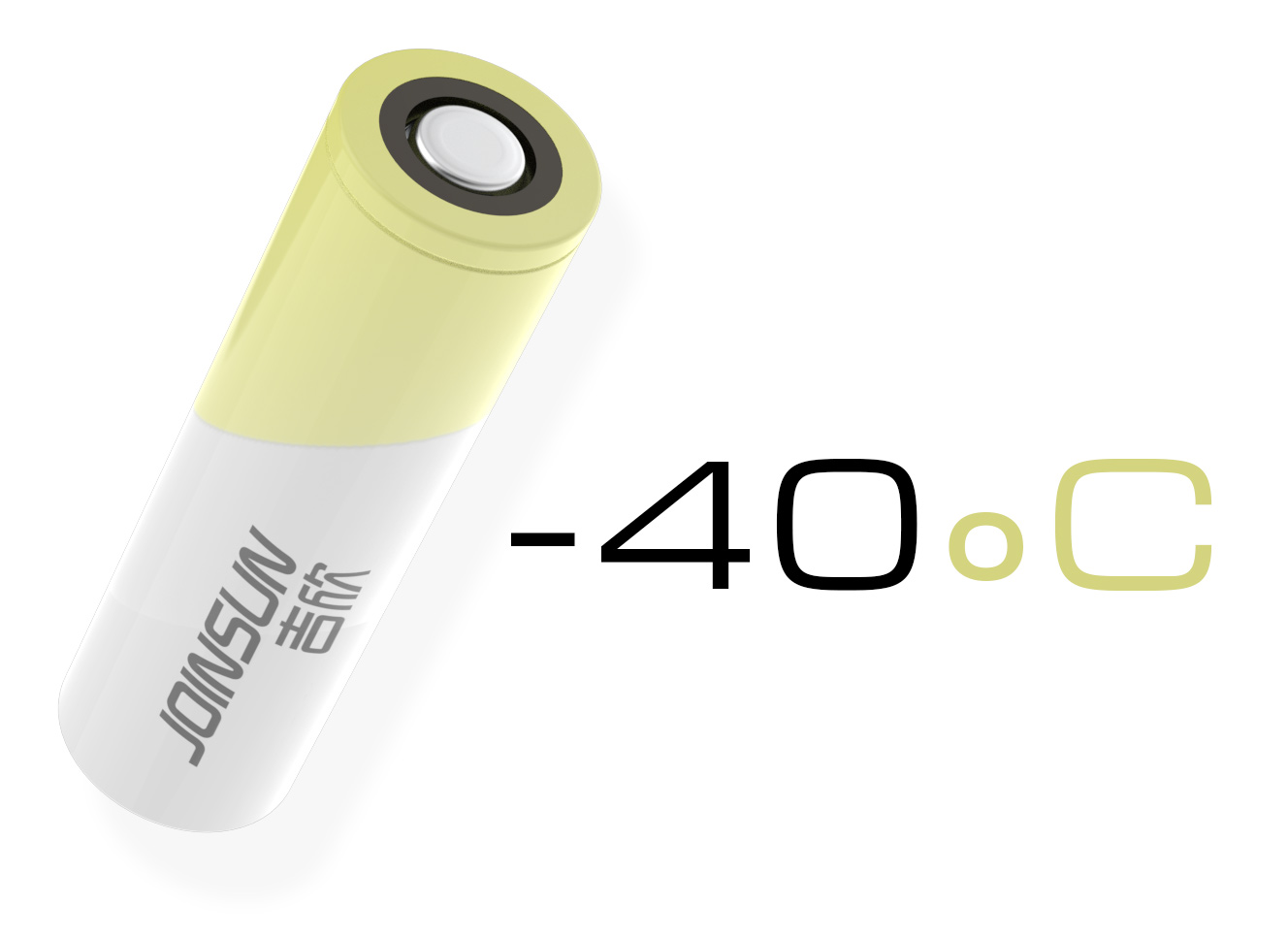
When the temperature drops to -40°C, a standard 18650 ternary cell turns into a lump of metallic stone — its discharge capacity may plummet to just 5–10% of room temperature performance, while internal resistance skyrockets to over 20 times its normal value. However, some specialty 18650 battery cells now claim to retain more than 60% of their capacity at -40°C, even supporting low-rate 0.2C cycling. The secret isn’t in the cathode or anode — it’s in the electrolyte.
Where the Cold Strangles Lithium Ions
In the NCM ternary system, the crystal structures of both electrodes can still intercalate and deintercalate lithium ions at -40°C — just extremely slowly. The real bottleneck is the electrolyte.
A conventional electrolyte consists of a lithium salt (mostly LiPF₆) mixed with carbonate solvents like EC, DMC, EMC, and DEC. Ethylene carbonate (EC) is essential because it forms a stable Solid Electrolyte Interphase (SEI) on the graphite anode. But EC has a melting point of 36°C. Even when blended with lower-melting solvents, the eutectic point of the whole mixture typically stays between -20°C and -30°C. Below -30°C, the electrolyte begins to partially crystallize, its viscosity rises exponentially, and lithium ion mobility grinds to a halt.
Two Paths to a New Electrolyte
For an 18650 ternary cell to work at -40°C, the electrolyte solvent system must be radically changed. Two technical approaches dominate:
(1) All Low-Melting-Point Solvent Systems
Remove EC entirely. Replace it with carboxylate esters such as methyl propionate (MP, m.p. -87°C), ethyl acetate (EA, m.p. -84°C), or methyl butyrate (MB, m.p. -85°C). These solvents have melting points 40–60°C lower than carbonates and show much slower viscosity rise at low temperatures. The trade-off? Without EC, the graphite anode struggles to form a dense, protective SEI. The solution involves adding small amounts of fluoroethylene carbonate (FEC, m.p. approx. -20°C) or using additives like VC and PS, combined with special formation protocols, to produce an SEI that remains flexible even in extreme cold.
(2) Ultra-Low Salt Concentration + Localized High-Concentration Electrolyte (LHCE)
The standard 1M LiPF₆ tends to precipitate out at -40°C. Simply lowering the concentration to 0.3–0.5M avoids salt crystallization but reduces ionic conductivity. A more advanced approach uses Localized High-Concentration Electrolyte (LHCE) — a high concentration of lithium salt (2–3M) is dispersed using an inert diluent such as HFE. This creates lithium-rich clusters while keeping the overall viscosity lower than that of a standard 1M electrolyte. At -40°C, such formulations can still maintain ionic conductivity above 1 mS/cm.
Real-World Performance and Hidden Trade-offs
Testing these specialty 18650 battery cells (e.g., certain low-temperature versions of the NCR18650 or military-grade cells) reveals:
(1) At -40°C, 0.2C discharge: capacity retention of 55–70%
(2) Internal resistance rises from ~20 mΩ at room temperature to 150–200 mΩ
(3) 1C discharge? Not feasible — polarization becomes too severe, and voltage instantly drops below 2.5V
The trade-offs are substantial. High-temperature performance collapses. After one week of storage at 60°C, capacity loss can exceed 30%, accompanied by significant gas generation. Rate capability is also universally poor — anything above 0.5C is a struggle.
Where to Buy One?
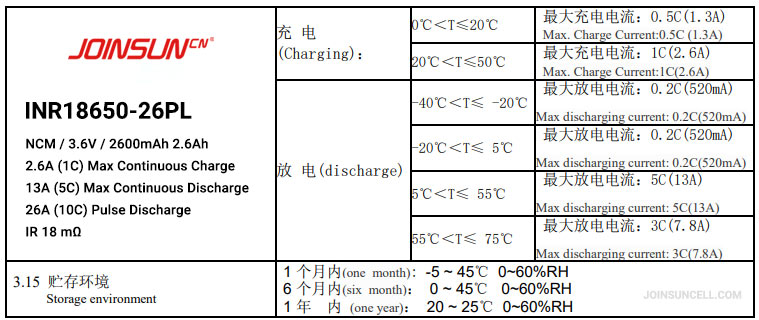
Most "low-temperature" 18650 battery cells available to consumers are rated for only -20°C or -30°C. Genuine -40°C grade cells are typically made for industrial or military applications: polar equipment, high-altitude balloons, satellite batteries. What consumers might occasionally find are used pulls like the JOINSUN NCM INR18650-26PL (2600mAh).
JOINSUN NCM INR18650-26PL (2600mAh) Specifications
Nominal Voltage: 3.6V
Norminal Capacity: 2600mAh (2.6Ah)
Limited Charge Voltage: 4.2V
Discharge Cut-off Voltage: 2.75V
Weight: 47g
Standard Charge Current: 0.52A (0.2C)
Max Continuous Cycle Charge Current: 2.6A (1C)
Max Continuous Cycle Discharge Current: 13A (5C)
Max Pulse Discharge Current: 26A (10C)
Cycle Times: 300 (5C) ~ 500 (3C)
Internal Resistance: ≤ 18 mΩ (1000 Hz)
Energy Density: 199 Wh/kg, 566 Wh/L
Charge Temperature: 0°C to 50°C
0°C to 20°C: 0.5C Charge,
20°C to 50°C: 1C Charge
Discharge Temperature: -40°C to 75°C
-40°C to 5°C: 0.2C Discharge,
5°C to 55°C: 5C Discharge,
55°C to 75°C: 3C Discharge
 To purchase, click here.