The 18650 Battery for Logistics Drones
Blog | Published by Alex on September 29, 2026
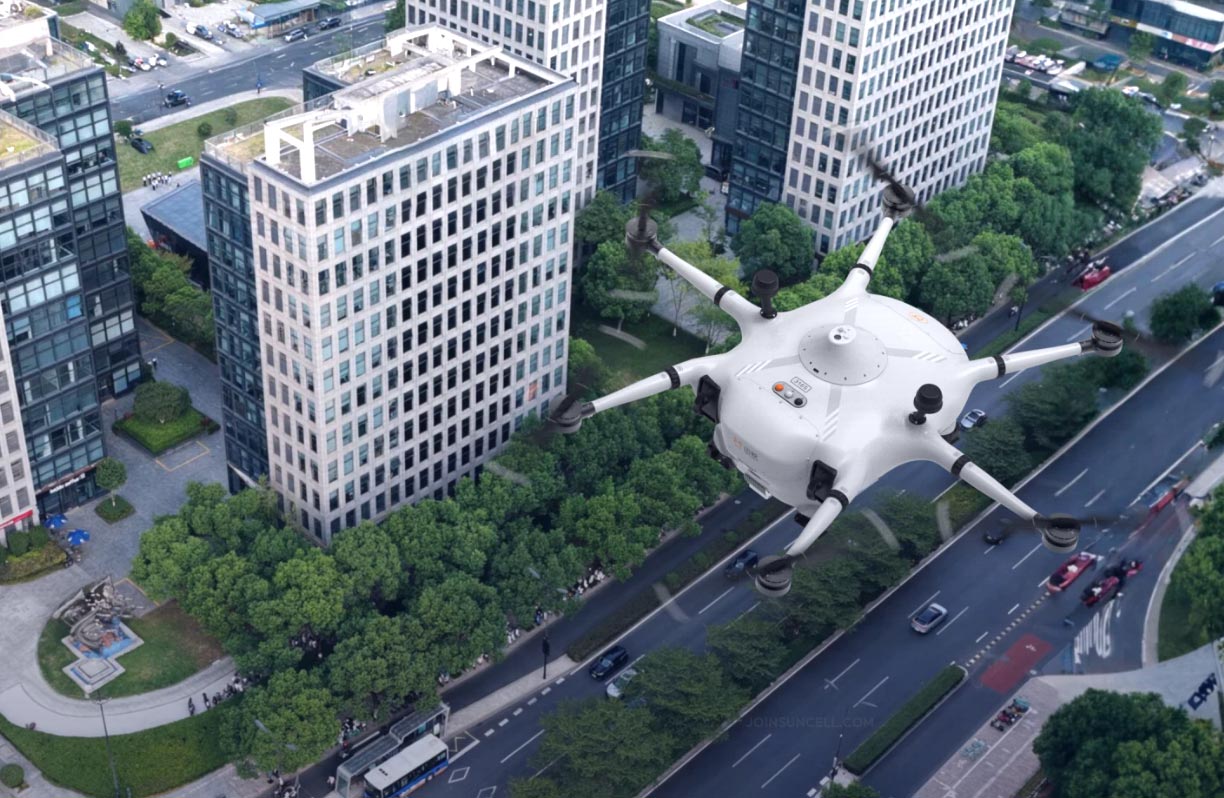
With the rapid development of low-altitude economy, the smart logistics system is undergoing continuous transformation and upgrading. As core intelligent equipment for last-mile delivery, short-distance material transportation and supplies resupply in remote areas, logistics drones break the spatial and scenario limitations of traditional ground logistics. Whether for last-mile parcel delivery in urban communities, instant fresh food delivery for supermarkets, material delivery in geographically isolated regions such as mountainous areas, islands and disaster zones, or material transfer in industrial parks, logistics drones demonstrate outstanding advantages of high efficiency, convenience and low operating cost. As the core component of logistics drones, the power system directly determines flight endurance, load capacity, flight stability, operational safety and service life. It has become a key bottleneck restricting the large-scale commercialization of drone delivery. Among various power batteries,
Lithium-Ion 18650 batteries (NMC) have undergone decades of technological iteration and industrial mass production. Featuring high maturity, excellent safety stability, superior cost performance and flexible assembly characteristics, they have become the mainstream power configuration for small and medium-sized commercial logistics drones and occupy a core share of the power market for low-altitude logistics. This paper systematically introduces the technical characteristics of 18650 batteries, deeply analyzes their application advantages and practical scenarios in logistics drones, discusses existing technical shortcomings, and puts forward targeted optimization schemes and future development trends combined with industrial progress.
The 18650 battery adopts a metal steel shell encapsulation with a regular wound internal cell structure, delivering excellent compression resistance, impact resistance, deformation resistance and vibration resistance. During daily operation, logistics drones frequently experience bumping during takeoff and landing, air turbulence at low altitude, fuselage vibration caused by obstacle avoidance, and even minor scratches and collisions. The rigid casing of 18650 batteries effectively avoids safety hazards such as cell damage, electrolyte leakage and internal short circuits, greatly improving operational safety under complex working conditions and perfectly adapting to the high-frequency, all-weather and multi-scenario commercial operation requirements of logistics drones.
Economy and durability are core advantages that enable the large-scale popularization of logistics drones powered by 18650 batteries. Cost reduction and efficiency improvement represent the core pursuit of the logistics industry. To replace manual delivery and short-distance vehicle transportation, drone delivery must control equipment procurement and operation & maintenance costs. High-quality industrial-grade 18650 batteries achieve 800 to 1000 charge-discharge cycles, far exceeding the 300 to 500 cycles of ordinary lithium polymer batteries. Logistics drones can make dozens of round delivery trips every day. Under long-term high-frequency charge-discharge conditions, 18650 batteries exhibit slow capacity attenuation and stable performance, which greatly reduce battery replacement frequency and cut equipment renewal costs for enterprises. Meanwhile, 18650 batteries are standardized general products without the need for customized mold opening. Benefiting from large-scale mass production and transparent market prices, the assembly, maintenance, replacement and capacity expansion of battery packs are simple with low operation thresholds. For logistics enterprises, the comprehensive operation and maintenance cost of power systems using 18650 battery packs can be reduced by more than 30% compared with customized battery solutions, delivering strong commercial competitiveness.
In terms of power performance, high-rate 18650 batteries specially developed for drones can realize continuous 10C and pulse 12C high-current output, fully meeting the instantaneous high-power demands of logistics drones during takeoff, climbing, loaded hovering and headwind flight. During delivery, cargo load and air turbulence will cause sudden increases in power load. 18650 batteries feature stable voltage output and rapid power response, which can effectively prevent fuselage shaking, flight deviation and cargo falling caused by power fluctuations, and significantly improve the stability and accuracy of delivery operations. In addition, these batteries have an extremely low self-discharge rate with little power loss during long-term idle storage, matching the intermittent standby and off-peak operation mode of logistics drones and reducing power waste.
In practical engineering applications, 18650 batteries can be flexibly combined in series and parallel with a battery management system (BMS) to adapt to logistics drones of different weights and application scenarios. Small last-mile delivery drones are used for urban small parcels, fresh food and medical supplies delivery. With light weight and small load capacity, they generally adopt multiple 18650 cells connected in series to form packs with lightweight battery modules. They can achieve stable flight endurance of 20 to 40 minutes and cover an urban last-mile delivery range of 3 to 12 kilometers, fully satisfying the demand for instant logistics. For medium-sized heavy-load logistics drones and long-distance delivery drones for mountainous regions, multiple 18650 battery packs are connected in parallel to expand capacity, greatly increasing the total battery capacity and discharge power, lifting the load limit and flight range of drones. This design adapts to high-intensity operation scenarios such as mountain material resupply, emergency relief supply delivery and heavy material transfer in industrial parks. Meanwhile, the supporting intelligent BMS can monitor the voltage, temperature, internal resistance and remaining power of each cell in real time. It provides comprehensive protection against overcharge, overdischarge, overtemperature, overcurrent, short circuit and cell imbalance, preventing thermal runaway of batteries from the system level and greatly enhancing operational safety for drones under complex weather such as high temperature, low temperature and rainy conditions.
Despite the comprehensive advantages of 18650 batteries, non-negligible technical shortcomings remain during the high-end and full-scenario popularization of logistics drones, restricting further performance improvement. First of all, the space utilization rate is relatively low. As 18650 cells adopt a fixed cylindrical standard structure, gaps exist between cells after series-parallel assembly. Compared with shape-customizable lithium polymer batteries, the overall volume of the battery pack is larger with lower space utilization. In the compact fuselage layout of drones, it occupies more space and increases the overall weight, limiting the load capacity and endurance upgrade potential. Thus, it is difficult to adapt to ultra-long-range and heavy-load large logistics drones. Secondly, the adaptability to extreme environments is insufficient. The optimal operating temperature range of ordinary 18650 batteries is 20℃ to 40℃. Under high-temperature exposure in summer, severe cold in winter or low-temperature and low-pressure environments at high altitudes, the chemical activity of cells drops sharply, resulting in reduced discharge efficiency and severely shortened flight time. Long-term operation under extreme working conditions accelerates cell aging, shortens the service life of the whole battery pack and affects the stability and continuity of drone operations.
Besides, the control of cell consistency is a common industrial challenge. A battery pack for logistics drones usually consists of dozens or even hundreds of 18650 cells connected in series and parallel. Even cells from the same production batch have subtle individual differences in internal resistance, capacity and attenuation rate. During long-term high-frequency charge-discharge cycles, performance differences keep accumulating, leading to premature attenuation of partial cells and capacity imbalance. This in turn degrades the performance of the whole battery pack, manifested as shortened flight time and insufficient power. In severe cases, local overheating may occur and bring potential safety hazards. In addition, traditional 18650 battery packs have relatively low charging speed, and high-power fast charging tends to damage cells. It cannot meet the fast energy replenishment requirement for all-weather non-stop and high-frequency rotation operations of logistics drones, which to some extent reduces the overall efficiency of logistics delivery.
To address the above technical weaknesses, the industry continuously optimizes the performance of 18650 batteries for logistics drones through material upgrading, structural optimization, intelligent management and process improvement. At the cell selection stage, mainstream drone manufacturers adopt industrial-grade high-consistency, wide-temperature-range and low-attenuation high-nickel 18650 cells. They reduce cell performance differences at the source and improve adaptability to high and low temperatures. Some special cells support stable operation within a wide temperature range from -20℃ to 60℃. In terms of battery pack structural design, the industry continuously optimizes series-parallel architecture, adopts lightweight integrated packaging technology and fills thermally conductive insulating materials to reduce gaps between cells and improve space utilization. Integrated heat dissipation air ducts, thermal conductive patches and low-temperature preheating modules are equipped to realize rapid heat dissipation at high temperatures and preheating at low temperatures, effectively mitigating battery performance degradation under extreme environments. At the intelligent control level, high-precision active equalization BMS is upgraded to dynamically adjust the charge and discharge state of each cell in real time, automatically compensating capacity differences, eliminating uneven cell attenuation and greatly extending the service life of the whole battery pack. Meanwhile, safe fast-charging technology compatible with 18650 batteries is maturing, significantly improving energy replenishment efficiency without damaging cells and adapting to high-frequency rotation operation of drones.
From the development trend of low-altitude economy and smart logistics, 18650 batteries will remain the optimal power solution for small and medium-sized logistics drones for a long time in the future. With continuous iteration of lithium battery materials, the popularization of high-nickel cathodes, silicon-based anodes and new electrolytes will further improve the energy density, rate performance, wide-temperature adaptability and safety of 18650 batteries and gradually make up for existing weaknesses. At the same time, supporting technologies including battery echelon utilization, intelligent energy storage refueling and wireless fast charging will further reduce battery operation and maintenance costs of drones and improve operational efficiency.
In summary, with safe and stable performance, mature technology, excellent cost performance and flexible assembly capability, 18650 batteries fully meet the core commercial requirements of logistics drones for high-frequency operation, multi-scenario adaptation and low-cost maintenance. They serve as a core power carrier balancing power performance, safety and economic cost of drones at the current stage. Their drawbacks such as low volume utilization, poor adaptability to extreme environments and inconsistent cell performance can be effectively alleviated through technical upgrading and structural optimization. In the booming wave of low-altitude logistics industry, 18650 batteries will keep iterating and upgrading to empower the large-scale and regular commercial application of logistics drones, solve the bottlenecks of last-mile logistics delivery, and provide solid power support for the transformation and upgrading of smart logistics as well as the industrialization of low-altitude economy.
JOINSUN INR 18650-22P 2200mAh 10C (22A) High C-rate NMC Lithium-Ion Battery Specifications:
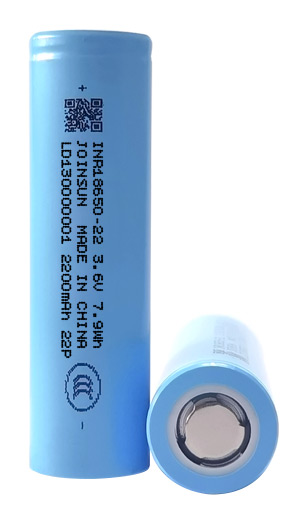
□ Nominal Voltage: 3.6V
□ Limited Charge Voltage: 4.2V
□ Discharge Cut-off Voltage: 2.5V
□ Max Continuous Charge: 2.2A (1C)
□ Max Continuous Discharge: 22A (10C)
□ Pulse Discharge: 26.4A (12C)
□ Weight: 45.5g
□ Discharge Temperature: -20 to 75°C
□ Charge Temperature: 0 to 50°C
□ Cycle Life (80% DOD): 300 (Continuous 10C Discharge), 600 (Continuous 5C Discharge)
□ Lithium Type: NMC Lithium
□ Battery Type: 18650 Battery
□ China Factory: Joinsun
Contact Joinsun