The Risks of Mixing Lithium NCM and Lithium LFP LiFePO4 21700 Batteries (Including Charger Compatibility Issues)
Blog | Published by Alex on April 21, 2025 | Contact Joinsun
Same size, different chemistry — read this before mixing 21700 Battery
In the world of lithium batteries, the
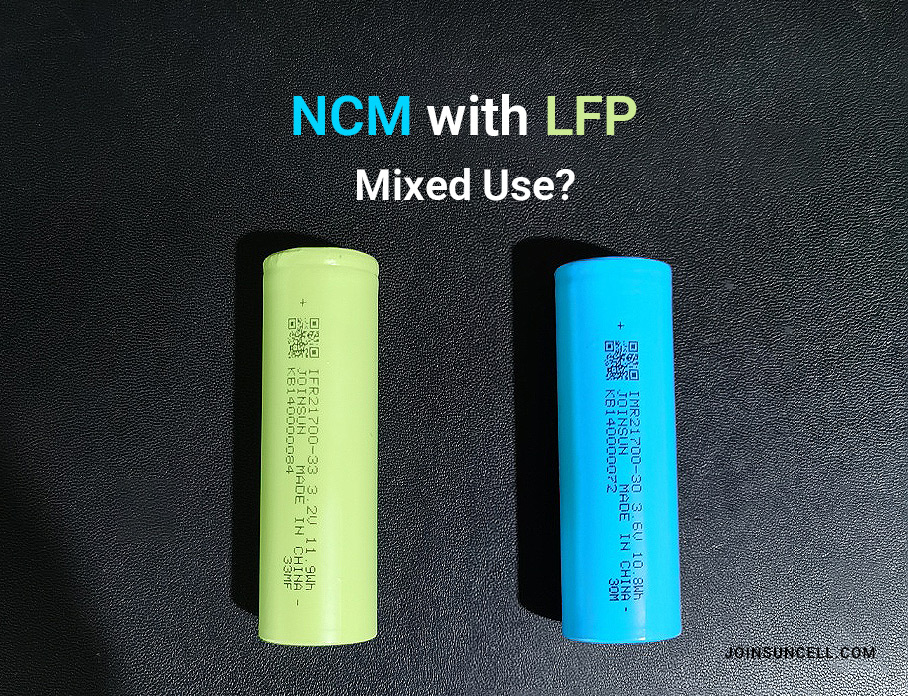
21700 battery format (21mm diameter, 70mm height) has become increasingly popular due to its high energy density and good thermal performance. It's widely used in power tools, energy storage systems, DIY battery packs, and even electric vehicles. However, many users overlook a critical question: Can NCM (Lithium Nickel Cobalt Manganese) and LFP (Lithium Iron Phosphate) cells — both in 21700 size — be mixed? Can chargers be interchanged?
This article will explore the real risks of mixing these two battery types, helping you avoid safety hazards and performance degradation.
Joinsun
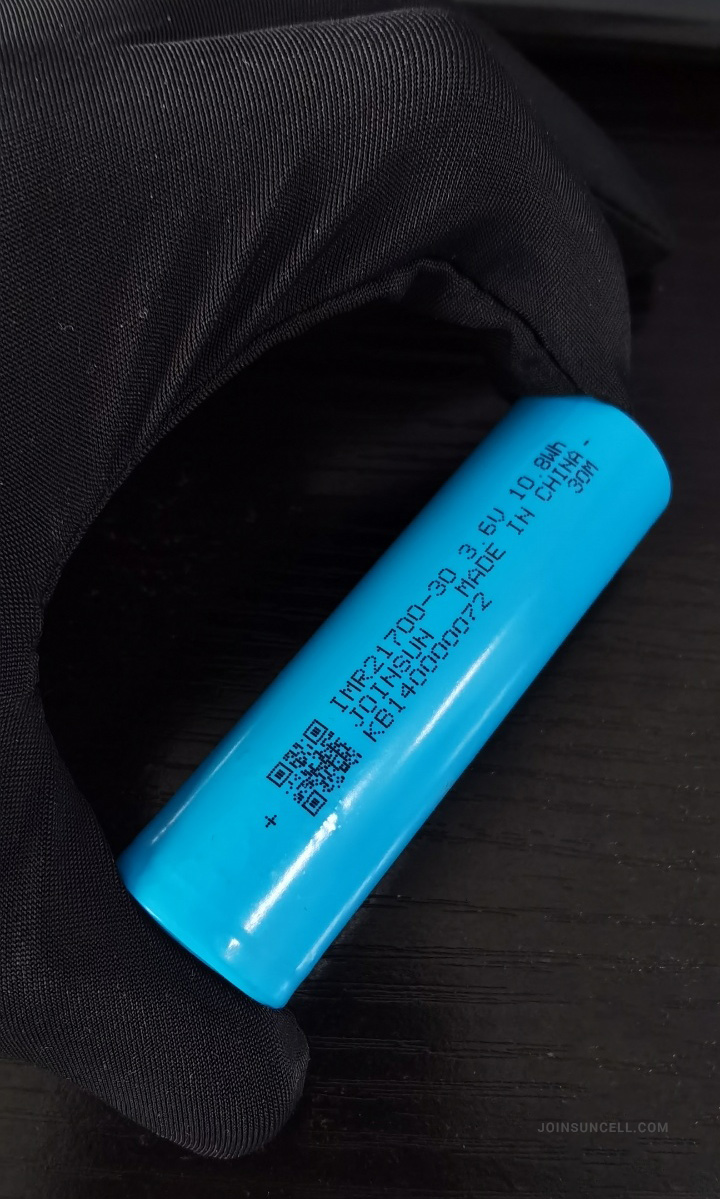
21700-33M 3300mAh NCM Lithium-ion Battery Cell, 5C 16.5A Max Discharge.
1. Core Differences Between NCM and LFP
Before discussing the risks of mixing, it's essential to understand their fundamental characteristics:
| Specs |
NCM 21700 |
LFP 21700 (LiFePO4) |
| Nominal Voltage |
3.6V / 3.7V |
3.2V |
| Max Charge Voltage |
4.2V (some High Voltage types 4.35V) |
3.65V |
| Discharge Cut-off Voltage |
~2.5V-2.8V |
~2.0V-2.5V |
| Energy Density |
High (~250-300Wh/kg) |
Lower (~120-160Wh/kg) |
| Cycle Life |
Medium (500-1000 cycles) |
Long (2000-5000 cycles) |
| Thermal Stability |
Poor (thermal runaway 150°C to 200°C) |
Excellent (thermal runaway >270°C) |
In simple terms: NCM offers high voltage and high energy density; LFP provides long cycle life and superior safety.
2. The 5 Major Problems When Mixing NCM and LFP 21700 Battery
2.1 Voltage Platform Mismatch → Over-discharge or Overcharge Risks
When cells with different voltage platforms are connected in series or parallel:
In series: The cell with the smallest capacity discharges first. If LFP (3.2V) is mixed with NCM (3.7V), the protection threshold is set based on the higher voltage, causing the LFP cell to be over-discharged or even reverse-polarity.
In parallel: The higher-voltage NCM will try to charge the lower-voltage LFP, creating circulating current. The initial voltage difference can exceed 0.5V, and the resulting instantaneous high current may cause heating, internal short circuits, or even fire.
Wrap-up: Never mix NCM and LFP cells in the same battery pack.
2.2 Extremely Low Capacity Utilization
Consider a 4S battery pack (4 cells in series) mixing 2 NCM + 2 LFP cells:
During discharge, LFP voltage drops to its cut-off threshold first. The BMS will cut off output prematurely, leaving the remaining capacity in NCM cells completely unusable.
Total usable capacity ≈ LFP capacity × number of cells in series — the energy density advantage of NCM is entirely lost.
2.3 Uneven Heating Due to Internal Resistance Differences
NCM typically has lower internal resistance than LFP (especially at high discharge rates). When mixed:
The higher-resistance LFP cells generate more Joule heat, accelerating aging.
Uneven heat distribution can trigger localized thermal runaway.
2.4 BMS Cannot Manage the Pack Correctly
Most commercial BMS units are specifically designed for either ternary lithium (4.2V/cell) or LFP (3.65V/cell). Mixing cells causes:
Incorrect overvoltage protection thresholds: Under-protection for NCM, over-protection for LFP.
Balancing circuit failure: Unable to balance voltages across two different chemistries.
2.5 Drastically Reduced Cycle Life
LFP's cycle life is 3-5 times longer than NCM's. When mixed, NCM cells degrade first, which then affects the entire pack's consistency. The overall pack life is limited by the weakest cell — the NCM.
3. Charger Mixing Problems: More Dangerous Than You Think
Many users assume "they're both
21700, chargers should be interchangeable." This is a serious misconception.
3.1 Using an NCM Charger (4.2V/cell) to Charge LFP Batteries
(1) Problem: Overcharging. LFP's full charge voltage is only 3.65V. A 4.2V charge forcibly exceeds the safe upper limit, causing LFP cells to swell, generate internal gas, and in severe cases, trigger thermal runaway.
(2) Real-world example: A user charged a 4S LFP pack (14.6V full) with a ternary lithium charger outputting 16.8V. The pack emitted smoke and was destroyed.
3.2 Using an LFP Charger (3.65V/cell) to Charge NCM Batteries
Problem: Undercharging. NCM requires 4.2V to reach its rated capacity. Using a 3.65V charger only provides about 50-60% of capacity. Long-term undercharging also destabilizes NCM's internal crystal structure, accelerating degradation.
3.3 Can "Smart Chargers" Automatically Detect the Difference?
A very small number of high-end chargers (e.g., some SkyRC and ISDT models) offer manual or automatic battery type recognition, but only under these conditions:
(1) The battery must have a communication interface (e.g., smart batteries with data terminals).
(2) The user manually selects the correct charging parameters.
For standard 21700 bare cells, chargers cannot automatically distinguish between NCM and LFP. Using the wrong charger almost certainly leads to overcharging or undercharging.
4. Safety Recommendations: Rules You Must Follow
1. Never mix cells — Within the same device, use only cells of the same brand, model, batch, and chemistry.
2. Use dedicated chargers — NCM cells require ternary lithium chargers (4.2V/cell); LFP cells require LiFePO4 chargers (3.65V/cell). If using a multi-chemistry charger, manually verify the voltage mode before each use.
3. Label clearly — Use a permanent marker or label to mark "NCM 3.7V" or "LFP 3.2V" on the cell wrapper to avoid confusion.
4. Use a proper BMS — For battery packs, always match the protection board to the specific chemistry (ternary or LFP).
5. Don't judge by appearance — 21700 is only a size specification, not an indicator of internal chemistry. Always keep the manufacturer's datasheet.
5. Common Misconceptions
| Misconception |
Fact |
| "They're both 3.7V lithium, mixing is fine." |
LFP is 3.2V — a 0.5V difference is enough to cause dangerous circulating currents. |
| "The charger will adapt automatically." |
99% of consumer chargers lack chemistry recognition. |
| "Adding a diode solves the problem." |
Diodes introduce voltage drop and heat, unsuitable for high-current power applications. |
| "Low current discharge is safe." |
Even at low currents, long-term voltage mismatch still leads to over-discharge/overcharge. |
| "Mixing cells of the same size but different brands is fine as long as voltage looks similar." |
Different brands have varying internal resistance, capacity curves, and safety vent designs — mixing increases imbalance and risk of thermal runaway. |
| "I can just use a resistor to balance voltages between NCM and LFP when connecting in parallel." |
Resistors only work during connection but cannot compensate for different charge/discharge plateaus; voltage will drift again immediately under load. |
| "Storing NCM and LFP batteries together in the same box is perfectly safe." |
If terminals accidentally touch or a metallic object bridges them, a short circuit can occur. Also, damaged cells of different chemistries may cross-contaminate if venting. |
| "All 21700 batteries have the same maximum continuous discharge rating." |
NCM and LFP cells vary widely (10A to 45A+). Exceeding the lower-rated cell's limit causes overheating and premature failure. |
| "It's safe to replace a dead LFP cell in a pack with an NCM cell as long as the voltage matches at that moment." |
The pack's BMS is calibrated for one chemistry. Voltage under load and charge termination will be mismatched, leading to immediate overcharge or undercharge of one cell. |
| "Using a higher voltage charger for a short time won't damage LFP cells." |
Even brief overvoltage (e.g., 4.2V on a 3.65V LFP cell) can cause lithium plating, internal gas generation, and permanent capacity loss. |
| "NCM batteries charge faster, so mixing them with LFP will improve overall charge speed." |
Charge speed is limited by the slowest chemistry (LFP generally accepts lower C-rates for full saturation). Mixing creates unbalanced cell voltages and BMS confusion. |
| "I can ignore the BMS if I only mix two cells for a small DIY project." |
Without a proper BMS matched to both chemistries, one cell will inevitably be over-discharged or overcharged — a known fire risk even in small projects. |
| "LFP and NCM have similar self-discharge rates, so they can be stored in series without balancing." |
Self-discharge rates differ significantly. After weeks of storage, voltage divergence worsens, and reconnecting without balancing causes large inrush currents. |
| "The 'smart' charger label means it can handle any 21700 cell automatically." |
Most 'smart' chargers only detect cell count and possibly NiMH vs Li-ion, but cannot distinguish NCM from LFP without manual voltage setting — user error remains common. |
| "If both batteries are new and fully charged, mixing them in a device should work normally." |
Initial voltages may match (e.g., NCM at 4.2V, LFP at 3.65V — they never match). Even if voltages are artificially equalized, discharge curves differ entirely; the LFP will hit cut-off much sooner, wasting NCM capacity and causing repeated deep discharge stress on LFP. |
| "Parallel mixing is safer than series mixing because voltages can equalize." |
Parallel mixing is actually more dangerous at the moment of connection. The voltage difference (0.5V+) creates a massive inrush current that can weld contacts, damage cell internals, or cause immediate thermal runaway. Series mixing at least allows BMS per-cell monitoring (though still unsafe). |
| "I've done this before and nothing bad happened, so it must be fine." |
Survivorship bias. Lithium battery failures are often delayed — cumulative damage from micro-overcharge, lithium plating, or internal heating weakens the cell over cycles. A fire may not happen on the first use, but the risk compounds with every charge/discharge cycle. |
| "Mixing NCM and LFP will give me the best of both worlds — high energy density and long cycle life." |
In reality, you get the worst of both: low usable capacity (limited by LFP's lower voltage), reduced cycle life (limited by NCM's shorter lifespan), and serious safety risks. No advantage is retained. |
| "I can use a universal balance charger that supports both Li-ion and LiFePO4 modes by toggling the setting, even if cells are mixed in one pack." |
A charger can only apply one charge algorithm at a time. If the pack contains mixed chemistries, charging in Li-ion mode overcharges LFP cells; charging in LiFePO4 mode undercharges NCM cells. Physical separation of packs is mandatory. |
| "Adding a protection circuit per cell (like individual fuses) makes mixing safe." |
Fuses prevent overcurrent but cannot solve voltage mismatch, different state-of-charge curves, or BMS incompatibility. Cells will still drift apart, and the pack will fail prematurely or unsafely. |
| "If I only mix them for a single emergency use, there's no long-term risk." |
Even a single mixed discharge can cause one cell to reverse polarity (if in series) or high cross-currents (if in parallel). Internal damage may not be visible but reduces future safety and reliability. Emergency use is not worth the fire hazard. |
| "LFP is safer, so adding LFP cells to an NCM pack will make the whole pack safer." |
Safety is determined by the most volatile chemistry and weakest link. NCM cells still pose thermal runaway risk regardless of LFP presence. The mixed configuration adds new failure modes without improving overall safety. |
| "I can mix them if I never fully charge or fully discharge, staying in the middle voltage range." |
The middle voltage ranges still differ (e.g., NCM ~3.8V vs LFP ~3.3V at 50% SOC). Constant imbalance remains, and any BMS protection thresholds are still mismatched. Partial operation does not eliminate cumulative damage. |
Epilogue
NCM 21700 and LFP 21700 batteries are like gasoline and diesel — both can power an engine, but they should never be mixed. Same size does not mean interchangeable. Whether mixing cells or chargers, you face a triple threat: reduced lifespan, wasted capacity, and safety risks.
If you're designing or repairing battery packs, always adhere to the principle of chemical consistency. Safety is not a small matter — proper matching is the only way to realize the true advantages of lithium batteries.