21700 Battery Export: Complete Certification and Logistics Workflow
Blog | Published by Alex on August 12, 2026
Comprehensive Compliance and Shipping Procedure for 21700 Lithium-Ion Cells (UN3480) – A Full Technical Guide
1. Mandatory Transportation Safety Test: UN38.3 Certification
UN38.3 is the core safety standard specified in Section 38.3 of the United Nations
Manual of Tests and Criteria for the transport of lithium batteries. This certification is
strictly mandatory for all air, sea, and land transport of
21700 batteries, and has been fully adopted by the International Civil Aviation Organization (ICAO), the International Air Transport Association (IATA), and the International Maritime Organization (IMDG).
Carriers will refuse shipments without a valid UN38.3 test summary.
This certification must be conducted by a third-party laboratory accredited with
ISO/IEC 17025 (e.g., CVC, TÜV, SGS). The testing period is approximately
5 to 7 working days. If a sample fails a test (e.g., leakage during drop test, bulging under high temperature), the lab provides a rectification plan (e.g., thickening the cell shell, adjusting packaging cushions). The test must be passed in sequence.
The following
8 core tests simulate extreme environments encountered during cross-border logistics:
| Item |
Test Name |
Specific Conditions |
Pass/Fail Criteria |
| T.1 |
Altitude Simulation |
Storage at 11.6 kPa (low pressure) for ≥ 6 hours. |
No leakage, venting, disintegration, rupture, or fire. |
| T.2 |
Thermal Cycling |
10 cycles between -40°C and +70°C, total duration ≥ 7 days. |
Open Circuit Voltage (OCV) ≥ 90% of initial value; no rupture or fire. |
| T.3 |
Vibration |
Frequency sweep 7 Hz – 200 Hz, 12 sweeps per 3 orthogonal axes. |
No disintegration, structural damage, or fire. |
| T.4 |
Shock |
150g peak acceleration, half-sine shock, 18 shocks total. |
No disintegration, rupture, or fire. |
| T.5 |
External Short Circuit |
Short circuit at 55°C with resistance < 0.1Ω. |
Max surface temp ≤ 170°C; no rupture/fire within 6 hours. |
| T.6 |
Impact/Crush |
9.1 kg weight dropped from 61 cm onto the cell. |
No disintegration, rupture, or fire within 6 hours. |
| T.7 |
Overcharge |
Overcharge at 2x current/voltage for 24 hours. |
No disintegration, rupture, or fire within 7 days. |
| T.8 |
Forced Discharge |
Reverse discharge by connecting a 12V DC supply. |
No disintegration, rupture, or fire within 7 days. |
Special Additional Test
If a single package contains
more than 24 cells, a
1.2-meter free drop test of the complete package is required to verify packaging integrity.
Validity Notice
The UN38.3 test summary does not have a fixed expiration date. However, if the cell design, materials, or manufacturing process undergo significant changes (e.g., cathode material change, electrolyte formulation change), a
partial or full retest is required.
2. Essential Shipping Documentation: MSDS and Transport Classification
After passing UN38.3, the following documents are required for carrier review and customs clearance:
2.1 Material Safety Data Sheet (MSDS)
An MSDS provides detailed information on the chemical composition, hazard classification, leakage emergency measures, and firefighting advice for the cells.
Requirement: Must be in English (or the official language of the destination country).
Standard: Must comply with the Globally Harmonized System (GHS) of classification and labeling.
Content: Sections 1-16, including Section 14 (Transport Information) specifying UN3480, Class 9, and packing group.
2.2 Transport Classification Certificate
This certificate is issued by authorized institutions (e.g., Shanghai Institute of Chemical Industry, DGM). It certifies that the specific batch of goods can be transported as Class 9 dangerous goods.
Critical Notice: Separate certificates are required for
Air and
Sea transport.
Validity: Typically valid until
December 31st of the current year (Annual renewal required).
3. Packaging Compliance: Dangerous Goods Packaging Certificate
For 21700 cells (single cell energy rating > 20Wh), the packaging must be certified for dangerous goods according to the UN Model Regulations, IMDG Code, and IATA DGR.
3.1 Overview of the Packaging System
The packaging structure typically consists of three layers:
1.
Inner Layer: Individual bubble wrap or polyimide tape covering the exposed positive/negative terminals (to prevent short circuits).
2.
Intermediate Layer: Honeycomb paper grids or ESD-suction trays to fix cells in place, preventing shifting.
3.
Outer Layer: Strong corrugated carton boxes meeting the
II Performance Level.
3.2 Certification Application Process (Two Steps)
Step 1: Packaging Performance Test Report
Applicant: The packaging manufacturer.
Authority: Local Customs/Inspection Agency.
Content: Proves the strength, sealing, and durability of the empty box/crate.
-------------------
Step 2: Use of Packaging Appraisal (The "Wei Bao Zheng")
Applicant: The cell manufacturer (exporter).
Authority: Local Customs authority at the place of production.
-------------------
Required Materials:
- Application form for packaging inspection.
- Packaging performance test report (from Step 1).
- Factory self-inspection conformity certificate.
- Dangerous goods classification report.
-------------------
On-site Inspection focuses on:
1.
UN Packaging Marking: Correct, durable, and legible UN codes on the package.
2.
Anti-Short Circuit Measures: Terminals are insulated; stacked packages do not squeeze cells.
3.
Separation Materials: Non-conductive dividers between cells to prevent contact.
-------------------
Validity:
-
Air: 3 months.
-
Sea/Land: 1 year.
-
Note: The certificate is valid for a single shipment only (one batch, one use) and cannot be shared across different batches without re-inspection.
4. Destination Market Safety Approvals
Beyond transportation compliance, the cells must meet the destination country's safety standards for customs clearance and market sale.
4.1 CB Certification (Global Foundation)
Standard: IEC 62133 (Secondary cells and batteries containing alkaline or other non-acid electrolytes).
Value: "One test, multiple approvals." Under the IECEE framework, a CB certificate covers over
50 countries.
Strategy: Obtaining CB certification allows entry into EU (CE), US (UL), and Japan (PSE) by only paying for minor national difference tests, saving significant time and cost.
Key Note: Must select a lab recognized by the IECEE. Otherwise, the report may be rejected by the destination country.
4.2 European Market (EU)
-
CE Marking: (LVD Directive 2014/35/EU + EMC Directive 2014/30/EU).
-
EN Standard: EN 62133 (Cell safety).
-
New Battery Regulation (EU 2023/1542): Requires carbon footprint declaration, recycled material content, and digital battery passport (starting 2027).
-
RoHS: Directive 2011/65/EU (Restriction of Hazardous Substances).
-
REACH: Regulation (EC) No 1907/2006 (SVHC notification).
4.3 US Market
-
UL 1642: Standard for Lithium Batteries (Cell level safety).
-
UL 21700: Specific standard framework for this form factor (increasingly required by buyers).
-
FCC: Part 15 for cells with smart monitoring/BMS features.
-
49 CFR: US Transport regulations (overlaps with UN requirements).
4.4 Other Major Markets
-
Japan: PSE (JIS C 8712).
-
Korea: KC Certification.
-
Southeast Asia: TISI (Thailand), QCVN (Vietnam).
-
Middle East: SASO (Saudi Arabia).
5. Pre-Shipment Execution: SOC and Declaration
5.1 State of Charge (SOC) Control
Regulation: Effective
January 1, 2026, ICAO/IATA requires that all lithium batteries transported by air must have a
State of Charge (SOC) not exceeding 30%.
Reason: To minimize the energy available for thermal runaway, significantly reducing fire risk in the cargo hold.
Evidence: A mandatory
"Lithium Battery SOC Declaration Letter" must be issued and signed by the shipper.
5.2 Dangerous Goods Declaration
A licensed freight forwarder or carrier must submit the declaration electronically.
Shipping Accuracy: Correct identification on the Air Waybill / Bill of Lading.
-
UN Number: UN3480.
-
Proper Shipping Name: "Lithium Ion Batteries" (or "Lithium ion batteries").
-
Hazard Class: 9.
-
Packing Group: II.
Required Annexes: UN38.3 Test Summary, MSDS, and a copy of the Dangerous Goods Packaging Certificate.
Legal Warning: Misdeclaration (e.g., omitting UN3480) can result in massive fines (up to $100,000+ in some jurisdictions), confiscation of goods, and criminal liability.
5.3 Package Marking and Labeling
The outer packaging must display the following:
1.
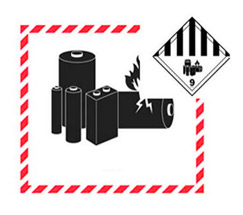
Class 9 Hazard Label: Diamond shape with black and white stripes.
2.
Lithium Battery Handling Label: Showing the UN number and a cautionary phone number.
3.
"Cargo Aircraft Only" (CAO): For UN3480, passenger aircraft transport is strictly prohibited. The CAO label is mandatory.
6. Operational Timeline Checklist
A practical timeline for a complete export operation is estimated below:
| Stage |
Timeline |
Critical Tasks |
| Pre-Production |
10-15 Working Days before shipment |
Apply for UN38.3 (5-7 days); Prepare MSDS; Apply for Transport Certificate; Procure "Wei Bao Zheng." |
| Booking |
3-7 Days before departure |
Select DGR carrier; Submit full documents for pre-approval; Reserve dangerous goods cargo space. |
| Dangerous Goods Declaration |
1 Working Day before cut-off |
Submit DG declaration to maritime/aviation authority; Obtain port/airport entry permit. |
| Customs Clearance |
Half a Day before customs cut-off |
Submit export declaration; Attach "Wei Bao Zheng" and supporting documents; Cooperate with physical inspection if required. |
| Departure |
Scheduled date |
Shipping: IMDG segregation; Air: CAO cargo hold. |
Summary of the Compliance Chain
The legal export of 21700 lithium-ion cells consists of a complete chain:
UN38.3 Test → Transport Classification Certificate → Dangerous Goods Packaging Certificate → Destination Market Safety Certifications (CB/UL/CE) → SOC Control → Declaration → Licensed Transport Carrier.
Each link has its own legal basis, testing standards, and operational procedures. Failure to comply with any single item can lead to cargo detention, financial penalties, or legal liability. Exporters must strictly verify their shipping method (Air/Sea/Land) and destination country requirements well in advance.